Learning Quantum Circuits with Queries
We pose an open problem on the complexity of learning the behavior of a quantum circuit with value injection queries. We define the learning model for quantum circuits and give preliminary results. Using the…
The research question
We pose an open problem on the complexity of learning the behavior of a quantum circuit with value injection queries. We define the learning model for quantum circuits and give preliminary results. Using the…
Read the original paper for precise definitions, assumptions, and numbered questions. The dated archive notes below describe reported progress and the remaining questions.
Lean 4
No Lean statement or proof is attached yet. Have a formalization? Share its source to add it to this problem.
Read the original paper Full text & figures
Open Problem: Learning Quantum Circuits with Queries
Jeremy Kun (JKUN2@UIC.EDU)
Lev Reyzin (LREYZIN@MATH.UIC.EDU)
Department of Mathematics, University of Illinois at Chicago
Abstract
We pose an open problem on the complexity of learning the behavior of a quantum circuit with value injection queries. We define the learning model for quantum circuits and give preliminary results. Using the test-path lemma of Angluin et al. (2009a), we show that new ideas are likely needed to tackle value injection queries for the quantum setting.
1. Introduction
Learning classical circuits with value injection queries (VIQ) was defined by Angluin et al. (2009b). In the VIQ model, one assigns values to subsets of the circuit wires and observes the output. This model has been extended to large alphabet, analog, and probabilistic circuits (Angluin et al., 2008, 2009a). There has also been work on learning networks with similar kinds of queries (Angluin et al., 2010; Kempe et al., 2003). Here, we ask how to learn a quantum circuit using VIQs. There is much work in physics on inferring the structure of specific quantum systems, but little on their generic learnability. Progress on this problem will bring together rich ideas from both the quantum and learning communities.
Model
A size quantum circuit on qubits is a list of gates , where each consists of an unitary matrix and a list of the indices of the qubits on which operates. A qubit is a unit vector in . Denote the basis vectors of as . The input to a quantum circuit is a unit vector in , the -fold tensor product of with itself, where each copy of corresponds to a qubit. We denote the basis vectors of by where is written as a binary string and is the tensor product of basis states from the copies of (called a pure state). In our model all inputs to quantum circuits will be pure states.
The computation of an input vector is as follows. In step the following is applied to : swap columns s.t. are the first 3 columns, apply the unitary map , and then reverse the column swap. Note that operations that only "depend" on three qubits can affect the entire state vector . After all gates are computed, is measured, returning index w.p. , and "collapses" to the basis vector .
An instance of our model is a pair of integers , an unknown quantum circuit on qubits of size , and an unknown permutation on masking the order of the gates. A function injection query (FIQ) is a tuple where , , and are unitary matrices. The response to a query is a string which is the final measured state of the quantum circuit formed by replacing the matrix of gate with for each and run on the starting state vector . We define an unmeasured variant where the query response is the entire state vector before measurement.
| with measurements | observing full state vector | |
|---|---|---|
| VIQ | open (fails test-path lemma) | open |
| FIQ | poly | poly |
Table 1: Summary of our results for learning quantum circuits with open problems in bold.
Given , a value injection of into a gate of a circuit with matrices operating on bits is an augmented circuit with three additional qubits fixed to the states and an additional gate following defined by swapping the new qubits with , respectively. One can similarly inject values into a subset of gate outputs. A value injection query (VIQ) is a tuple where and . The response to a query is a string which is the measurement of the first qubits of the final state of the quantum circuit formed by injecting each value into gate of and running the resulting augmented circuit on input . We define the analogous unmeasured variant as well.
An algorithm learns to -behavioral equivalence if for any circuit it outputs s.t. the distributions over responses to VIQs/FIQs for and differ by in norm. The query complexity of an algorithm is measured in the total number of VIQs/FIQs it uses, and it has been extensively studied for classical circuit families (Angluin et al., 2008, 2009a,b).
Open Problem Determine the query complexity of learning quantum circuits with VIQs.
2. Preliminary Results
Now we give some preliminary results on learning quantum circuits with VIQs and FIQs. These results elucidate which of the questions in Table 1 are known and which remain open.
2.1. Learning quantum circuits with FIQs
Proposition 1 There is a -query algorithm for learning a quantum circuit with FIQs (without measurement) to 0-behavioral equivalence.
Proof The algorithm learns the gates individually and then their order. First, for each gate and , query . With overhead (see below), assume gate acts on the first 3 qubits. Fixing and looking at all , each output vector consists of the th column of . Repeat on all gates makes FIQs. To find the qubits acts on: inject the identity everywhere except and a 3-cycle permutation at , and query each where is the string of 0s with a 1 at position .
Next sort the gates in queries, ordering two gates as follows. Fix two permutations that do not commute. Form by permuting the columns of the identity matrix according to . Inject the identity into every gate except , into , and into . Choose such that and input . If the order of matters the response to the query will differ, and it is trivial to determine the correct order. Note the comparisons do not need the full state vector. The query complexity is .
Measurement adds FIQs to the above algorithm to make it -approximate. Consider the case with two gates with operating on the same qubits. Decompose according to a basis of the vector space . Inject the identity everywhere but and inject all pairwise sums of basis operations to , query all 8 basis vectors, and measure the outputs. Using the basis coefficients of as variables, this gives a system of polynomial equalities in which all parameters are . It can be solved to accuracy . It is easy to see that the errors across gates grow linearly, and the general case is similar.
2.2. Quantum circuits fail the test path lemma with measured VIQs
Angluin et al. (2009a) use the idea of "test paths" (from Angluin et al. (2009b)), to bound the query complexity of learning boolean probabilistic circuits. Their analysis also shows test paths fail for probabilistic circuits with an alphabet size greater than two. We show quantum circuits have the same barrier by constructing a gadget analogous to that of Angluin et al. (2009a) (Lemma 8). Define as a matrix as in Figure 1. Further define the standard quantum XOR gate using an extra scratchwork qubit by the mapping .
Lemma 2 There is a circuit on which every (measured) VIQ leaving a path free makes the last output qubit uniformly random, yet with no VIQ the last output qubit is deterministic.
Proof Define on three qubits as in Figure 1. The circuit normally maps , , , and , i.e., the last qubit is 1 iff the input's first qubit is 1. Likewise, when the scratch-work qubit is 1, the output bit is flipped. When there is a VIQ, say, of 1 at the identity gate acting on the 2nd qubit, the mapping becomes , , , and . The extra qubit introduced by the VIQ is the last index, and the qubit of interest is the third qubit, which is uniformly random.
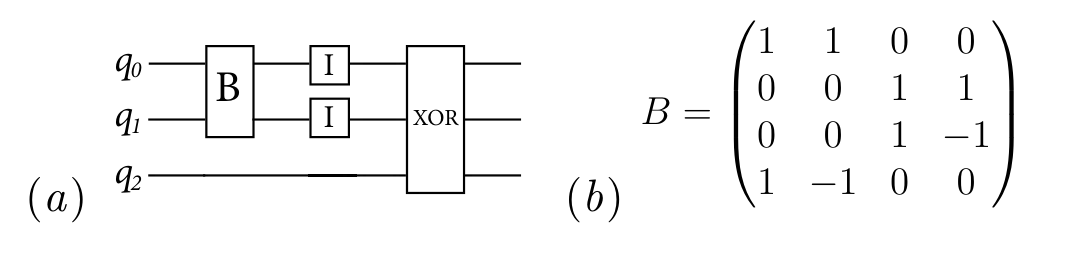 Figure extracted from page 3 of the published PDF (300 DPI crop).
Figure 1: Left: the circuit for Lemma 2. Right: the columns of form the Bell basis.
References
Dana Angluin, James Aspnes, Jiang Chen, and Lev Reyzin. Learning large-alphabet and analog circuits with value injection queries. Mach. Learn., 72(1-2):113–138, 2008.
Dana Angluin, James Aspnes, Jiang Chen, David Eisenstat, and Lev Reyzin. Learning acyclic probabilistic circuits using test paths. J. Mach. Learn. Res., 10(Aug):1881–1911, August 2009a.
Dana Angluin, James Aspnes, Jiang Chen, and Yinghua Wu. Learning a circuit by injecting values. J. Comput. System Sci., 75(1):60–77, January 2009b.
Dana Angluin, James Aspnes, and Lev Reyzin. Optimally learning social networks with activations and suppressions. Theor. Comput. Sci., 411(29-30):2729–2740, 2010.
David Kempe, Jon Kleinberg, and Éva Tardos. Maximizing the spread of influence through a social network. In Proceedings of the Ninth ACM SIGKDD, pages 137–146, 2003.
Questions & status notes Supplied archive · 2026-09-05
These notes reproduce the supplied archive’s summaries, some of which are abbreviated or truncated. Use the original paper for a complete mathematical statement. Reported resolutions may rely on unrefereed work.
Progress & source assessment
Read the archive’s progress assessment
- [1]Open Problem: Learning Quantum Circuits with Queries. COLT 2015. link
- [2]Original published PDF link
- [3]Open Problem: Learning Quantum Circuits with Queries (Semantic Scholar record, citations endpoint) (2015) linkEvidence cited by the supplied archive; not independently re-reviewed in this import.
- [4]Lev Reyzin - publications page (current through 2026) (2026) linkEvidence cited by the supplied archive; not independently re-reviewed in this import.
- [5]arXiv author listing for Reyzin (au:Reyzin), 31 papers through 2026-05 (2026) linkEvidence cited by the supplied archive; not independently re-reviewed in this import.
- [6]Learning a circuit by injecting values (2009) linkEvidence cited by the supplied archive; not independently re-reviewed in this import.
- [7]Learning shallow quantum circuits (2024) linkEvidence cited by the supplied archive; not independently re-reviewed in this import.
Recorded progress
Add yours →Nothing recorded yet. A pointer to a paper the entry is missing counts.
Machine attempts
0 recordedAttempts run against the statement below and are recorded in full, including the failures. The point is to stop the next model — and the next person — from re-walking a road that is already known to end. Each attempt costs 25 credits.
No machine attempts recorded.
Sign in to run an attempt. New accounts start with enough credits for ten.
Discussion
0 notesNotes are for clarifying the statement, flagging a missing reference, or recording why an approach fails. Claimed solutions belong in a submission, where they can be reviewed.
No notes yet.
Sign in to add a note.